
Have you ever walked into a room and felt your shoulders drop, your breathing slow, your thoughts settle? And then walked into another that felt heavy or restless, even though nothing looked wrong with it?
Most of us have. We just never stop to ask why.
Vastu Shastra is the ancient Indian science of buildings and the people inside them. It studies how directions, light, layout and the five natural elements shape the way a space feels - and, over time, the way we sleep, think, relate and live within it.
What is Vastu Shastra?
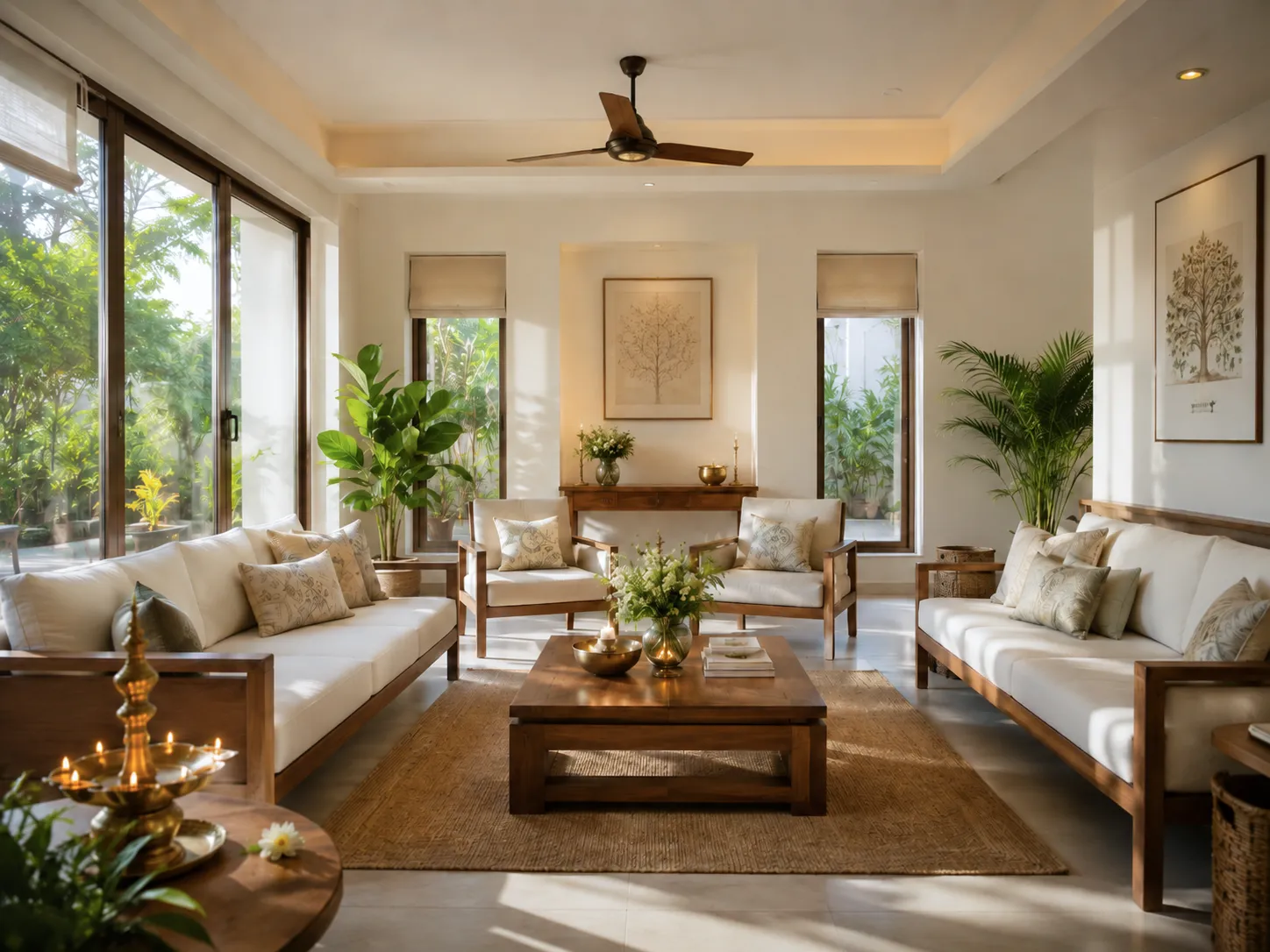
The word vastu means a dwelling, or the site a dwelling stands on. Shastra means a body of knowledge - a science, a teaching. Put together, Vastu Shastra is the knowledge of built spaces: how to place them, orient them, proportion them and live in them so that the building supports the people inside.
Many people think of Vastu as a checklist. Kitchen here, bedroom there, mirror definitely not there. But the checklist is only the surface. Underneath sits an old and rather elegant observation: human beings respond to their environment constantly, whether they notice it or not, and a home can be arranged to work with that response instead of against it.
Vastu works through two main tools. The first is the eight directions, each carrying its own quality - more on those shortly. The second is the five elements: earth, water, fire, air and space. Every zone of a home is associated with one of these elements, and balance between them is what Vastu aims for.
Is this superstition? I would call it something else: the psychology and energetics of space. Much of Vastu's logic is grounded in things you can point to. The sun rises in the east, so east-facing rooms receive gentle morning light - the kind that wakes the body naturally. The afternoon sun beats hardest from the southwest, which is one reason tradition places heavy walls and restful rooms there. Vastu noticed these patterns thousands of years before anyone had instruments to measure them.
Why do spaces affect us more than we realize?
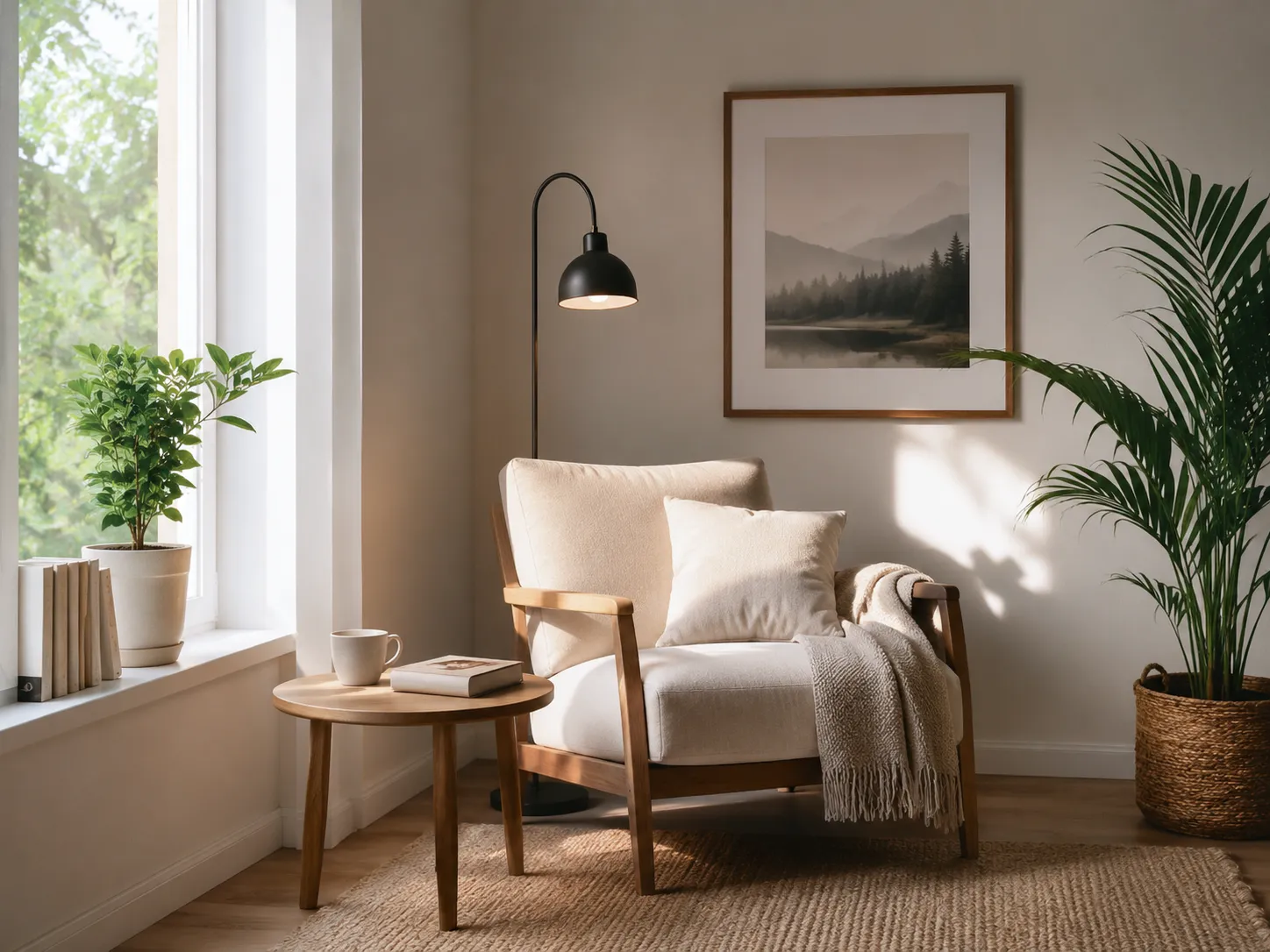
Think about how differently you feel in a temple, a cluttered storeroom, a hotel lobby, a hospital corridor. Same you. Completely different inner state - and it changes within seconds of walking in.
Environmental psychology has been measuring this for decades. Natural light regulates the hormones that govern sleep and mood. Clutter competes for your attention and quietly raises stress. Stale air dulls thinking; a stuffy meeting room makes everyone slower by the second hour. Noise keeps the nervous system on alert long after you have stopped consciously hearing it.
None of this is controversial. Where Vastu goes further is in adding a directional and elemental layer on top: not just how much light, but from where. Not just what a room contains, but what it is used for and in which part of the home it sits. You can treat that layer as energy, as tradition, or simply as a very old system of paying attention. It works as all three.
What does each direction mean in Vastu?
According to Vastu, each direction carries a different quality, tied to its element and to the path of the sun. Here is a short introduction - we will spend whole articles on these later in the series:
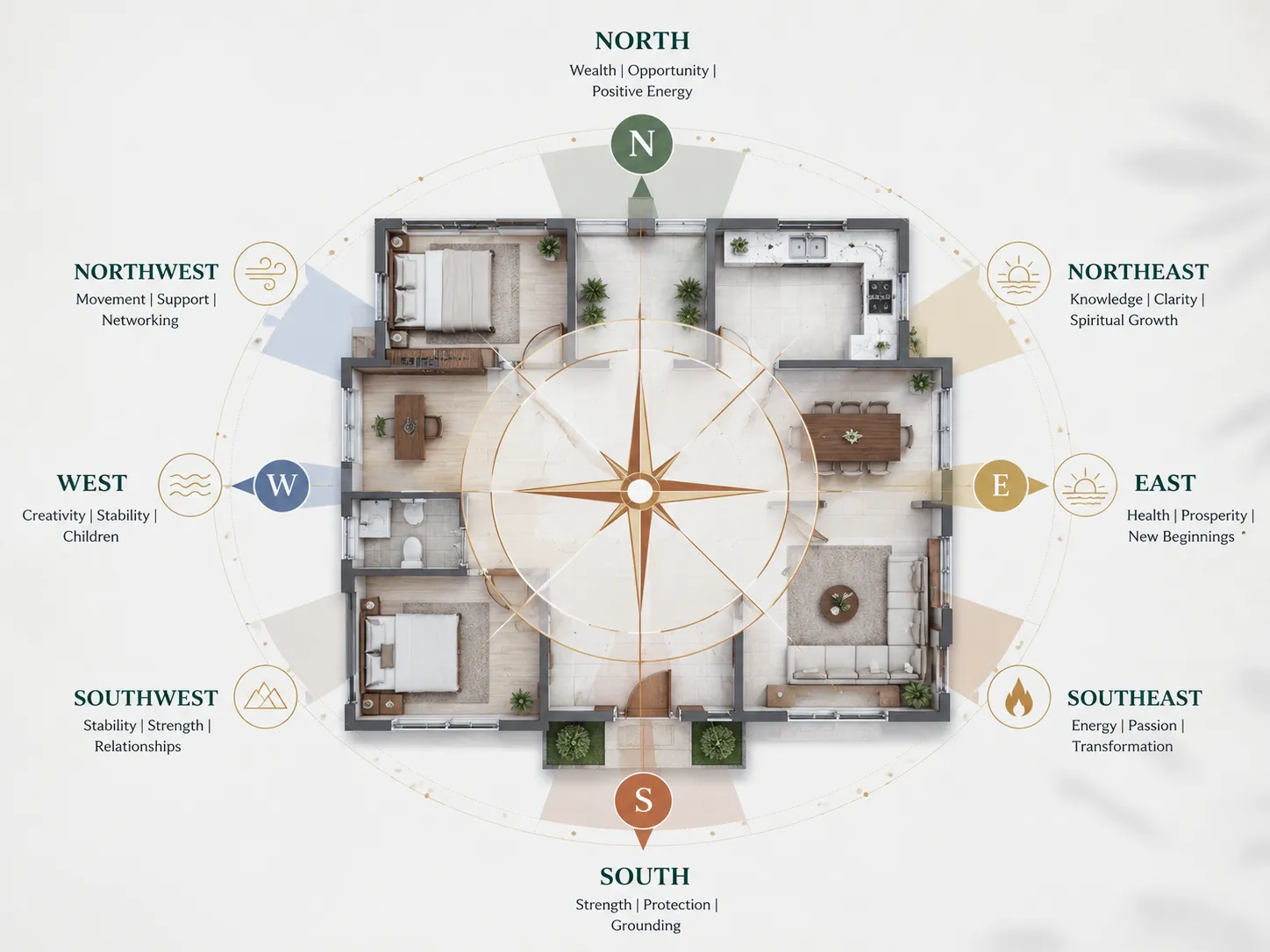
- East - sunrise, vitality, new beginnings. A natural place to start the day: breakfast, study, morning routines.
- North - flow, movement, opportunity. Tradition links it with Kubera, the lord of wealth. Keep it open and uncluttered.
- Northeast - clarity, intuition, stillness. Its element is water. The classic corner for prayer, meditation, or simply a quiet chair. Light and clean, always.
- Southeast - fire. The natural home of the kitchen and everything to do with heat and energy.
- Southwest - earth. Grounding, stability, permanence. Well suited to the master bedroom and to heavy furniture.
- Northwest - air. Movement and change: guests, things in transit, whatever is not meant to stay forever.
- The center - known as the Brahmasthan, belonging to the element of space. Vastu likes it open and breathing, not buried under storage.
Reading a list like this, it is tempting to run to your floor plan and start worrying. Please don't. If your kitchen sits in the "wrong" corner, your life is not broken - and a good consultant would never tell you it is. The directions are a map for understanding your home, and there is almost always a workable adjustment once you understand what a space needs.
Does Vastu work in apartments and rented homes?
This is the question I hear most often in the UAE, and for good reason. Most of us here live in high-rise apartments in Dubai or Sharjah, or in rented villas we did not design. You cannot move the front door. You cannot rotate the kitchen. The building was finished long before you arrived.
Classical Vastu texts were written for people constructing homes from the ground up. Living in a modern flat, you apply the same knowledge differently - through the layer you do control. Which room you sleep in, and which direction your head points at night. Where you set up your desk. Which corner holds the clutter and which holds the light. How each element shows up in your colors, materials and daily use of the space.
In practice, this layer is where most of the change happens anyway. And if you are about to choose a new home, a basic Vastu review of the layout before you sign the lease or sale agreement takes very little time - far less than living with a poor fit for years. This is exactly what a preliminary Vastu analysis is for.
Signs your home's energy may need attention
Homes have a way of communicating imbalance through repetition. Not one bad night. Patterns.
Some of the ones worth noticing:
- Sleep that never quite refreshes, even after eight hours
- Constant tiredness at home, while you feel fine elsewhere
- Difficulty focusing in one particular room
- Arguments that seem to cluster in one part of the house
- A room everyone avoids without being able to say why
- Restlessness, heaviness, or a persistent sense of being stuck
Now, an honest caveat, because authentic Vastu requires honesty: not every difficulty in life comes from your floor plan. Health, work and relationships have their own causes. But environment amplifies whatever pattern is already running. A supportive space will not solve everything - it makes everything easier to face. And in my consultations I have seen how even small energetic corrections in a home can shift the mood of the people living in it in ways that surprise them.
Vastu is about awareness, not fear
If you take one thing from this first article, let it be this. Vastu has developed a reputation, in some hands, for creating anxiety - dire warnings, expensive remedies, the suggestion that a house is somehow cursed. That is not Vastu. That is fear being sold with Sanskrit attached.
Authentic Vastu builds supportive environments, and it usually starts small:
- Declutter one room completely and notice how it feels to stand in it
- Open the windows and let air actually move through the home each day
- Give morning light a clear path into the rooms where your day begins
- Create one calm corner - a chair, a lamp, nothing else - and use it
- Fix the small broken things: the door that sticks, the bulb that died months ago
- Start noticing which direction each activity in your home happens in
Nothing on that list costs money. All of it changes how a home feels within a week. Your home should support your energy, not drain it - and support very often begins with simple attention.
Ask yourself
Before the next article in this series, sit with these five questions. Honest answers will teach you more about your home than any checklist:
- How do I feel in the first ten seconds after entering my home?
- Which room energizes me?
- Which space feels heavy - and when did it start feeling that way?
- Does my home actually support rest, focus and connection?
- Is my environment aligned with the life I am trying to build?
Sometimes the change we keep seeking outside begins with the space we return to every evening.
Common questions about Vastu Shastra
Is Vastu Shastra a religion?
No. Vastu grew up alongside Indian spiritual tradition and shares some of its vocabulary, but it is a body of architectural and spatial knowledge, not a faith. People of every background use it, the way people of every background use yoga or meditation.
Is Vastu scientific?
Parts of it align closely with what modern research says about light, ventilation and orientation. Other parts - the energetic qualities of directions, the role of the five elements - come from the traditional understanding of prana, or life energy, and sit outside what laboratories measure. At JH Lifestyle we present Vastu as a practical awareness tool. Take what you can verify in your own home; you will find that is quite a lot.
Does Vastu apply to rented apartments?
Yes, and this matters enormously in the UAE, where most residents rent. You do not need to own your home, renovate it, or move a single wall. Vastu in a rented flat works through room selection, sleeping direction, furniture arrangement, decluttering, light and elemental balance - all of it fully within a tenant's control.
What is the difference between Vastu and Feng Shui?
Both are traditional sciences of space, but they developed independently. Vastu comes from India and is built on fixed directions and the five elements; Feng Shui comes from China and centers on the flow of chi, with a more movable, remedial toolkit. They agree far more often than they differ. You can read our introduction to Feng Shui for a closer look.
How do I get a Vastu consultation in Dubai or Sharjah?
I offer a free 30-minute consultation - online or in person - where we talk through your home, your concerns, and whether a full review makes sense for you. No pressure, and certainly no fear. You can book it through our Vastu consultation page.
Dr. Jaya Harikumar is the founder of JH Lifestyle, a holistic living consultancy based in Sharjah Media City, UAE, offering Vastu, Feng Shui, sound healing and wellness consultations across the Emirates. Book a free 30-minute consultation.


